
PCT patent drawing requirements, set out in Rule 11 of the Patent Cooperation Treaty, differ from USPTO drawing rules under 37 CFR 1.84 in sheet-size defaults, color policy, sheet numbering, and the practical checks examiners apply once a case reaches national phase. WIPO’s international standard governs how drawings look and behave during the international phase, while the USPTO applies its own scale, lettering, and reproducibility checks the moment an application lands on an examiner’s desk in the United States. Drawings that pass Rule 11 review at the International Bureau are not automatically guaranteed to clear USPTO examination without adjustment.
Inventors who file through the Patent Cooperation Treaty often assume their drawing set is locked in for good once WIPO accepts it. That assumption creates expensive surprises later, usually right when an application enters the U.S. national phase and a USPTO examiner flags something the international phase never questioned. Working with professional PCT-to-USPTO patent drawing preparation services from the start closes this gap before it ever reaches an examiner’s desk, since a single, carefully built drawing set can be engineered to satisfy both rule systems at once rather than needing a costly rebuild later.
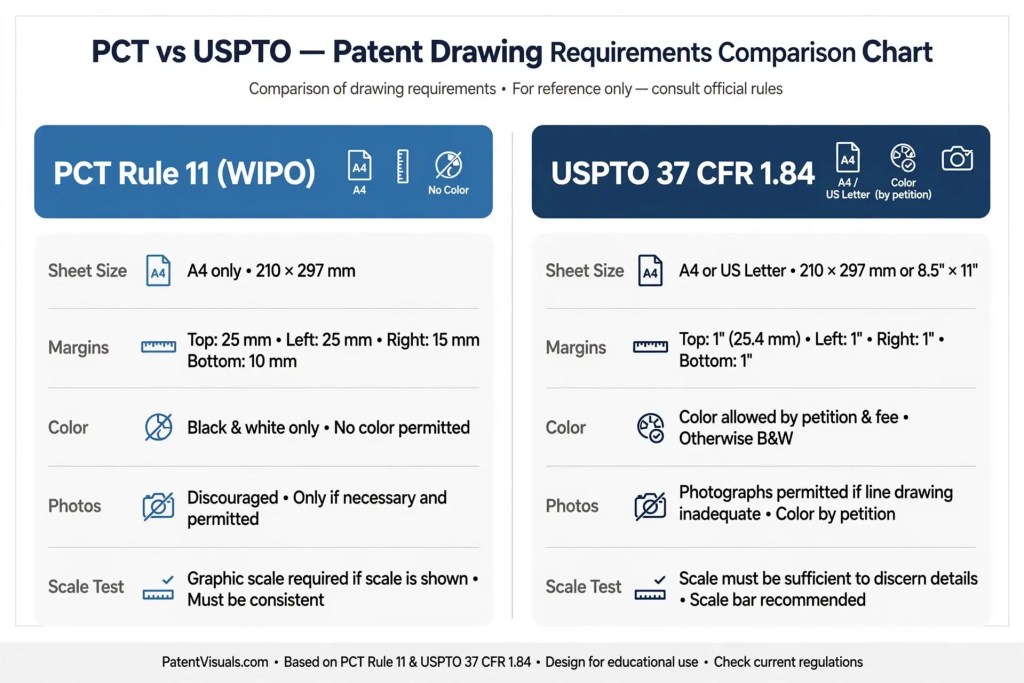
This guide breaks down exactly where PCT patent drawing requirements and USPTO rules overlap, where they diverge, and what that means for anyone planning to enter the U.S. national phase.
What Are PCT Patent Drawing Requirements?
PCT patent drawing requirements are the formal drawing standards set by the World Intellectual Property Organization (WIPO) under Rule 11 of the PCT Regulations and Section 302 of the PCT Administrative Instructions. They govern sheet size, margins, line quality, numbering, and reproducibility for every drawing filed with an international application.
In short, these rules exist for one reason: reproducibility. A drawing has to survive scanning, publication, and reduction without losing a single line of clarity, no matter which of WIPO’s more than 150 contracting states eventually reviews it.
- Governing body: World Intellectual Property Organization (WIPO)
- Primary rule: PCT Rule 11, supported by PCT Administrative Instructions Section 302
- Applies during: The international phase, before national phase entry
- Core goal: Uniform, reproducible drawings accepted across all PCT contracting states
The Legal Framework Behind PCT and USPTO Drawing Rules
Before comparing specifics, it helps to understand where each rule set actually comes from. They are not competing standards written in isolation; they share a common ancestry, which is exactly why they overlap as much as they do.
PCT Rule 11 at a Glance
PCT Rule 11 lays out the “physical requirements” for every international application, drawings included. It covers everything from paper material to line darkness, and it applies uniformly whether an applicant files in Geneva, Tokyo, or Washington.
Key elements of PCT Rule 11 include:
- Sheet size: A4 (21.0 cm x 29.7 cm) is the standard; a receiving office may accept other sizes, but the official record copy and the search copy must ultimately be A4.
- Usable surface: The drawable area may not exceed roughly 26.2 cm x 17.0 cm.
- No frames: Sheets cannot contain a border or frame around the usable or used surface.
- Line character: Every line, number, and letter must be durable, black, sufficiently dense and dark, and uniformly thick, without shading tricks that compromise reproduction.
- Sheet numbering: All sheets must be numbered consecutively in Arabic numerals, positioned in the center of the sheet, never inside the margin.
- Lettering size: Numbers and letters used on drawings must measure at least 0.32 cm in height.
37 CFR 1.84: The USPTO’s Drawing Standard
The USPTO’s counterpart lives in 37 CFR 1.84, “Standards for drawings,” reinforced by MPEP Section 608.02 for examiner guidance. This regulation runs from subsection (a) through (x) and covers nearly identical mechanical territory: paper, margins, line weight, and view types.
Because the United States played an active role in shaping the PCT’s physical requirements decades ago, 37 CFR 1.84 and PCT Rule 11 share a common backbone. That is precisely why so many applicants assume the two systems are interchangeable, when in reality several practical differences still trip up otherwise well-prepared drawing sets.
PCT Patent Drawing Requirements vs. USPTO Rules: Side-by-Side Comparison
The table below lines up the two standards point by point so you can see, at a glance, where PCT patent drawing requirements and USPTO rules genuinely diverge.
| Requirement | PCT Rule 11 (WIPO) | USPTO 37 CFR 1.84 |
|---|---|---|
| Sheet size | A4 required for the record and search copy | A4 or U.S. Letter (21.6 cm x 27.9 cm), applicant’s choice |
| Usable surface | Approx. 26.2 cm x 17.0 cm | 17.0 cm x 26.2 cm (A4) or 17.6 cm x 24.4 cm (Letter) |
| Margins (top / left / right / bottom) | 2.5 cm / 2.5 cm / 1.5 cm / 1.0 cm (minimum) | 2.5 cm / 2.5 cm / 1.5 cm / 1.0 cm (minimum, nearly identical) |
| Color drawings | Not permitted at the international phase, with narrow exceptions | Permitted only by petition, extra fee, and limited circumstances |
| Photographs | Discouraged; accepted only where no other medium works | Accepted under similar limited-circumstance rules |
| Sheet numbering | Centered at the top of the sheet, outside the margin | Centered at the top, consistent with PCT practice |
| Scale / reduction test | Must remain legible after standard reproduction | Must remain legible when reduced to two-thirds size; no “actual size” notations allowed |
| Frames around drawings | Strictly prohibited | Strictly prohibited |
| Reference characters | Must be consistent throughout the application | Must be consistent and match the specification exactly |
| National phase re-review | Not applicable (this is the international phase) | Every designated office, including the USPTO, re-checks drawings against its own formal rules |
As the table shows, the numeric margins are nearly the same, since 37 CFR 1.84 was written to harmonize with the PCT framework. The real friction shows up elsewhere: sheet-size flexibility, color policy, and the fact that USPTO examiners re-check everything from scratch during national phase entry.
Why These Differences Matter for Patent Prosecution Timing
Drawing compliance rarely feels urgent when an application is first drafted, yet it quietly shapes how quickly prosecution moves later. A single formal objection over margins, color, or missing views can add months to a timeline that otherwise had none of those delays built in.
Consider the practical chain of events. First, an examiner reviews the drawings before substantive examination even begins, since formal defects are typically resolved before an office action addresses novelty or obviousness. Next, if the drawings fail 37 CFR 1.84, the applicant receives a notice with a response deadline, usually a minimum of two months. Meanwhile, competitors filing cleaner applications in the same technology space may move through examination faster, which matters in a first-to-file system where priority dates and market timing both carry real weight.
There is also a cost dimension worth naming directly. A drawing correction filed reactively, after an office action, almost always costs more than the same correction made proactively during initial preparation, because reactive fixes involve rush turnaround, additional attorney review, and sometimes a second round of USPTO fees. Building a single drawing set that respects both PCT patent drawing requirements and USPTO rules from the outset is not just a formality; it is a straightforward way to protect both budget and priority timing.
Sheet Size and Margin Differences Between PCT and USPTO Drawings
Sheet size is the first place applicants get tripped up, mostly because both systems technically allow more than one option.
Under PCT patent drawing requirements, A4 paper is the default and the only format guaranteed to satisfy the record copy and the search copy WIPO forwards to the International Searching Authority. A receiving office may accept a different size at filing, but that flexibility disappears once WIPO standardizes the record.
The USPTO, by comparison, genuinely accepts either A4 or U.S. Letter size for the life of the application, provided the applicant stays consistent. Consequently, a drawing set built around A4 for PCT filing generally transfers cleanly into the U.S. national phase, though a set built around Letter size from day one may need reformatting if the applicant later files internationally through the PCT route.
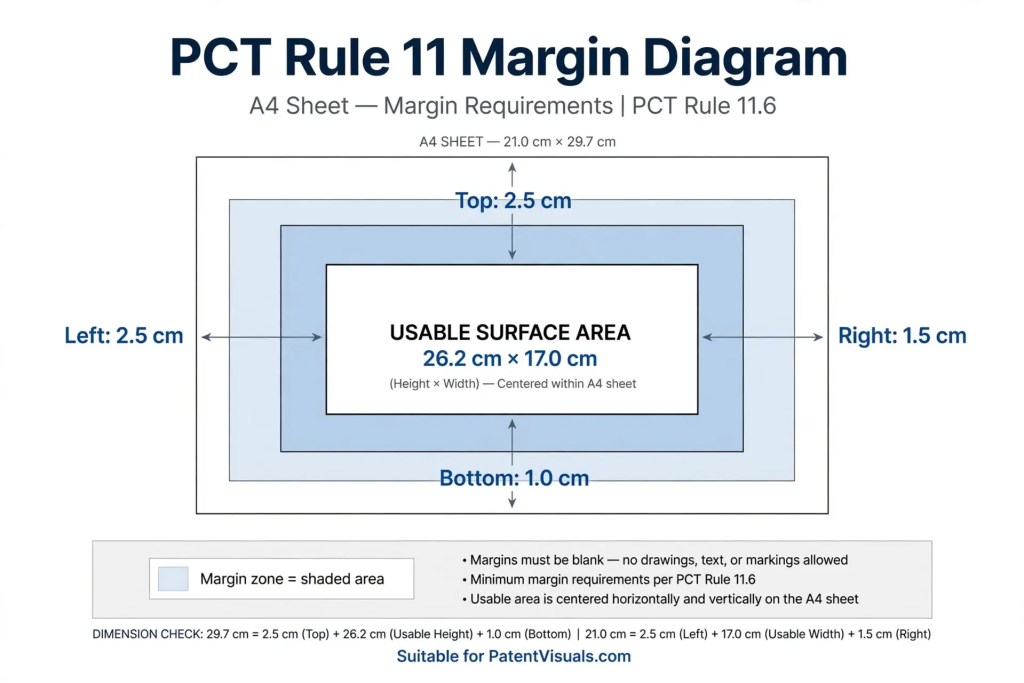
Margins matter just as much as sheet size, and here the numbers largely agree:
- Top margin: 2.5 cm minimum under both systems.
- Left margin: 2.5 cm minimum under both systems.
- Right margin: 1.5 cm minimum under both systems.
- Bottom margin: 1.0 cm minimum under both systems.
Neither office allows any drawing element, reference numeral, or figure label to cross into the margin. That single rule causes more formal objections than almost any other line item in 37 CFR 1.84, largely because designers crowd figure numbers too close to the sheet edge when trying to maximize usable space.
Line Quality, Shading, and Lettering Standards
Line quality is where “close enough” stops working. Both PCT Rule 11 and 37 CFR 1.84(l) demand lines that are durable, clean, black, sufficiently dense and dark, and uniformly thick. Faint, wispy, or inconsistent lines fail under both systems for the same underlying reason: they will not survive scanning and reduction without losing legibility.

Shading rules diverge slightly in emphasis rather than substance:
- PCT drawings allow shading and hatching for cross-sections, but the shading must stay uniform and never become so dense it obscures the underlying structure.
- USPTO drawings apply that same principle but add more explicit guidance for design patent surface shading, where the choice between straight-line shading and stippling actually communicates whether a surface is flat or curved. Skipping this step on a design application can trigger a non-enabling rejection.
Lettering size is another area where PCT Rule 11 is unusually specific: numbers and letters on the drawing must measure at least 0.32 cm in height, and Latin characters are required (Greek letters are permitted where customary, such as in mathematical or chemical notation). The USPTO does not restate an identical millimeter figure in 37 CFR 1.84, but MPEP guidance for examiners applies the same practical legibility test: if a number or letter disappears when the drawing is reduced to two-thirds size, it fails.
View and Figure Requirements: Utility vs. Design Patents
This is where accuracy matters most, because it is also where applicants most often mix up two separate systems.
Standard PCT applications, the kind most inventors file for utility protection, do not set a fixed number of required views. Instead, PCT Rule 11 and the PCT Applicant’s Guide require enough views, in enough detail, to disclose every claimed feature clearly. Flow sheets and diagrams count as drawings under the PCT framework, so a software or process-based invention can rely on flowcharts just as validly as a mechanical invention relies on cross-sections.
USPTO utility drawings follow the same underlying logic under 37 CFR 1.83 and 1.84: every claimed feature needs a corresponding view, whether that means a perspective drawing, a sectional view, an exploded assembly, or a schematic.
Important distinction: The Patent Cooperation Treaty does not cover industrial design applications. International design protection runs through the Hague System, not the PCT, and once a design application reaches the USPTO directly (or via Hague designation), an entirely different view-count standard applies, often a full set of standard orthographic views to fully disclose ornamental appearance.
If your invention also needs design protection alongside a utility filing, that drawing set follows its own checklist rather than PCT patent drawing requirements. Our design patent drawing checklist walks through exactly what the USPTO expects for that separate track, including view counts, broken-line conventions, and surface-shading rules.
Color Drawings and Photographs Under Each System
Color policy is one of the sharpest genuine differences between the two frameworks.
Under PCT patent drawing requirements, color drawings are not permitted during the international phase in the ordinary course. Black-and-white line drawings remain the default, and while later amendments to the Administrative Instructions opened a narrow path for color or photographic content in specific technical fields, that path involves additional procedural steps most applicants never need to trigger.
Under USPTO rules, color drawings and photographs are similarly restricted but through a different mechanism: an applicant must file a petition, pay the associated fee, and demonstrate that color is the only practical way to disclose the claimed subject matter. Even then, approval is limited to genuinely exceptional cases, such as certain biological staining images or specific material-science visuals.

The practical takeaway is straightforward:
- Default to black-and-white line drawings for both systems unless there is a compelling technical reason not to.
- Reserve color petitions for the USPTO national phase, since color is essentially unavailable during the PCT international phase.
- Never assume a color drawing accepted informally by one office will transfer cleanly to another; each designated office reviews color petitions independently.
From PCT to USPTO: What Happens at National Phase Entry
Entering the U.S. national phase does not simply “hand off” your drawings; it triggers a fresh formal review under 37 CFR 1.84, separate from anything WIPO already checked.

Here is what typically happens once a PCT application designates the United States:
- The USPTO receives the international application, along with any drawings filed during the international phase.
- An examiner reviews the drawings against 37 CFR 1.84, independent of whatever the International Bureau previously approved.
- Compliant drawings generally proceed without changes, since most PCT-compliant sets already satisfy the closely related USPTO margin and line-quality rules.
- Non-compliant elements trigger a formal notice, most often tied to color content, missing views, insufficient shading, or reference characters that no longer match an amended specification.
- The applicant receives a response deadline, which by statute cannot be shorter than two months from the date of the written notice.
According to the PCT Applicant’s Guide, drawings that comply with PCT Rule 11 at the international phase are often accepted at national phase without modification, but a designated office retains the authority to demand new or corrected drawings if the original set fails that office’s own formal requirements. In other words, PCT compliance is a strong starting point, not a guarantee.
Common Mistakes When Transitioning PCT Drawings to USPTO Filing
Most drawing objections at national phase entry trace back to a handful of avoidable errors. Watch for these:
- Assuming Letter-size and A4 are interchangeable without reformatting. Mixing sheet sizes within a single set, or failing to standardize before national phase entry, invites a formal objection.
- Carrying over faint or inconsistently weighted lines that passed a cursory international review but fail the USPTO’s two-thirds reduction legibility test.
- Letting reference numerals drift from the specification after amendments during the international or national phase, which creates a mismatch examiners flag almost immediately.
- Missing shading cues on design-adjacent drawings, particularly when an applicant later pursues design protection alongside a utility filing and reuses utility-style line art without adding the surface shading design applications require.
- Ignoring margin creep, where a figure label or lead line drifts a few millimeters into the margin after a late edit, which is a small mistake with an outsized consequence.
- Filing color images informally, assuming international acceptance implies USPTO acceptance without a proper petition and fee.
- Skipping the lead figure designation, since 37 CFR 1.84(j) requires one figure to be identified as most representative of the invention for front-page publication, a step the PCT phase does not emphasize the same way.
- Treating the two-thirds reduction test as optional, particularly for drawings that looked fine on a large monitor but lose fine detail the moment they are printed or scanned at production size.
Each of these mistakes is easy to prevent with a proactive drawing review before national phase entry, rather than a reactive fix after an office action arrives. Building that review into your filing checklist, rather than treating it as an afterthought once an objection lands, is consistently the difference between a one-pass national phase entry and a drawn-out correction cycle.
Expert Tips for Drawings That Satisfy Both PCT and USPTO Rules
A few habits consistently separate drawing sets that sail through both systems from sets that generate repeat objections:
Build for the stricter standard first.
Since PCT and USPTO margins are nearly identical, designing to the tighter of the two eliminates most rework later.
Default to A4 unless you know you are filing directly with the USPTO only.
A4 keeps the record copy compliant without any later conversion.
Test every sheet at two-thirds reduction before submission.
f a number, letter, or fine line disappears, the USPTO will flag it too.
Keep a master reference-numeral list.
Cross-check it against the specification every time either document changes, since mismatches are one of the most common causes of formal drawing objections.
Treat design and utility drawings as separate projects.
Even when they cover the same underlying product, because the rules genuinely diverge once design protection enters the picture.
Avoid color unless it is truly unavoidable.
When it is, plan the petition process into your USPTO timeline well before the response deadline.
Step-by-Step: Preparing PCT Patent Drawings for a Smooth USPTO National Phase

Follow this sequence when preparing a drawing set intended to survive both the international phase and USPTO national phase entry without a costly redo:
- Confirm sheet size and orientation before drafting begins, defaulting to A4 unless a specific filing strategy calls for Letter size.
- Set margins to the stricter minimums (2.5 cm top and left, 1.5 cm right, 1.0 cm bottom) so both PCT Rule 11 and 37 CFR 1.84 clear on the first pass.
- Draft in solid black line art, avoiding color and photographic content unless a petition is already part of the plan.
- Add uniform shading or hatching only where it aids technical clarity, keeping density consistent across every sheet.
- Number every sheet centrally at the top, and confirm figure and reference numbers stay well clear of the margin.
- Cross-check every reference character against the current specification immediately before filing.
- Run a two-thirds reduction test on each sheet, correcting anything that becomes illegible.
- Route the near-final set through a professional compliance review before international filing, then again before national phase entry, since amendments made during examination can quietly introduce new inconsistencies.
Frequently Asked Questions About PCT Patent Drawing Requirements
What is the difference between PCT and USPTO patent drawing requirements?
PCT patent drawing requirements govern the international phase under WIPO’s Rule 11, while USPTO rules under 37 CFR 1.84 apply once an application enters the U.S. national phase. The two share nearly identical margin rules, but they diverge on sheet-size defaults, color policy, and the formal re-review every designated office performs independently.
Do PCT-compliant drawings automatically satisfy USPTO rules?
Not automatically. Drawings that meet PCT Rule 11 during the international phase are often accepted at USPTO national phase entry without changes, but the USPTO can still require corrections or new drawings if the original set does not fully satisfy 37 CFR 1.84.
Can I use color drawings under PCT patent drawing requirements?
Generally, no. Color is not permitted during the standard PCT international phase, aside from narrow procedural exceptions. The USPTO allows color drawings only through a formal petition, an additional fee, and proof that color is genuinely necessary to disclose the invention.
What margins are required for PCT patent drawings?
PCT Rule 11 requires a minimum 2.5 cm top margin, 2.5 cm left margin, 1.5 cm right margin, and 1.0 cm bottom margin, with no drawing element permitted to cross into that space. These figures align closely with USPTO margin requirements under 37 CFR 1.84(g).
How many views does the USPTO require for a design patent drawing?
The PCT does not set a fixed view count because it does not cover design applications at all. For USPTO design filings specifically, the number of views depends on what is needed to fully disclose the ornamental design, which for many three-dimensional articles means a complete set of standard orthographic views rather than angled perspectives alone.
What happens if my drawings don’t meet PCT Rule 11 before national phase entry?
WIPO’s International Bureau can issue a formal deficiency notice with a correction deadline, and unresolved issues can still resurface as objections once the application enters national phase in any designated country, including the United States.
Can flow sheets and diagrams count as patent drawings?
Yes. Both PCT Rule 11 and USPTO practice treat flow sheets and diagrams as drawings, which matters significantly for software, chemical process, and systems-based inventions that rely on schematic disclosure rather than physical-object views.
Can I submit hand-drawn sketches for a PCT application?
Informal sketches can sometimes support a provisional filing, but they rarely satisfy PCT Rule 11 or 37 CFR 1.84 on their own. Both systems require durable, uniformly thick, well-defined lines, which hand sketches often lack once scanned and reduced, so most applicants convert sketches into formal CAD-based or illustrated drawings before international or national filing.
Does using CAD software automatically make my drawings compliant?
Not by default. CAD tools are excellent for producing precise source views, but the exported file still has to be checked against margin, scale, and lettering rules under both PCT Rule 11 and 37 CFR 1.84. Native CAD formats like .dwg or .step are not filing-ready on their own and need to be exported into a compliant drawing sheet format before submission.
Conclusion: Getting PCT and USPTO Drawing Compliance Right the First Time
PCT patent drawing requirements and USPTO rules share more common ground than most applicants expect, since the numeric margins, line-quality standards, and anti-frame rules line up almost exactly. Still, the gaps that remain, particularly around color policy, sheet-size defaults, and the independent review every designated office performs, are exactly the gaps that generate costly office actions during national phase entry. Applicants who plan for both standards from the first draft, rather than treating USPTO compliance as an afterthought, consistently avoid the delays and correction fees that come with reactive fixes.
If you want a drawing set engineered to clear PCT Rule 11 and 37 CFR 1.84 in a single pass, start your patent drawing project with our team and file your next application with confidence instead of guesswork.