
Provisional to nonprovisional patent drawing conversion is the formal redrawing process that transforms rough, informal sketches filed with a provisional application into black-and-white line drawings that meet 37 CFR 1.84 standards. The conversion must preserve every structural detail shown in the original sketch, because any feature missing from the formal drawing cannot claim the earlier priority date. Inventors often assume this step is a simple cleanup job, but examiners compare the two drawing sets line by line, and a dropped reference numeral or an altered proportion can quietly cost you a year of protection.
That risk is exactly why so many applicants turn to a dedicated patent illustration team instead of a general graphic designer for their patent drawing preparation and formal figure conversion services. A provisional application buys you twelve months of “patent pending” status, but that clock runs out fast, and the nonprovisional drawings you file afterward need to hold up under an examiner’s magnifying glass while still matching what you originally disclosed.
In this guide, you will learn exactly how provisional to nonprovisional patent drawing conversion works, which details examiners scrutinize most, the step-by-step workflow professional illustrators follow, and the common mistakes that quietly weaken priority claims. Whether you sketched your invention on a napkin or built a rough CAD model, this article will show you how to carry every ounce of technical detail forward into a formal, examiner-ready drawing set.
What Is Provisional to Nonprovisional Patent Drawing Conversion?
Provisional to nonprovisional patent drawing conversion refers to the process of redrawing informal figures – hand sketches, whiteboard diagrams, rough CAD exports, or photographs – into the formal line-drawing format the USPTO requires for a nonprovisional utility application.
A provisional application, by design, has no formal drawing requirements. Under USPTO guidance on provisional applications, an inventor can submit drawings that are legible but otherwise informal, since the provisional never gets examined on its own. That flexibility is useful early on, but it creates a gap: when the nonprovisional application is filed within the 12-month window, its drawings must comply with the strict formatting rules of 37 CFR 1.84, including consistent shading conventions, proper margins, numbered reference characters, and defined line weights.
The conversion process, therefore, is not just an aesthetic upgrade. It is a technical and legal exercise in translating every disclosed feature from the informal sketch into a compliant drawing, without adding new matter and without losing anything that was originally shown.

Quick Answer: Why This Process Matters
- A nonprovisional application’s drawings must trace back to what was disclosed in the provisional to keep the earlier filing date.
- Missing or altered details in the formal drawings can force the examiner to treat certain claims as if they were filed on the later, nonprovisional date.
- Consequently, careful conversion protects the priority date that the provisional application was meant to secure in the first place.
Why Priority Detail Preservation Is the Whole Point
Filing a provisional application establishes a priority date, and that date only protects what the provisional actually discloses. If your nonprovisional drawings introduce a feature, dimension, or configuration that was not clearly shown in the provisional sketches, the USPTO may treat that added detail as new matter.
New matter does not get the benefit of the earlier filing date. Instead, it is treated as though it were disclosed for the first time on the nonprovisional filing date, which can be fatal if a competitor published something similar in between. This is precisely why patent attorneys insist on drawings that are consistent from provisional through nonprovisional filing, rather than a total redesign dressed up as a “cleanup.”
Consider a few scenarios where lost priority detail becomes a real problem:
- A hinge mechanism sketched loosely in the provisional is redrawn with a completely different pivot point in the formal version, because the illustrator “improved” the design rather than faithfully translating it.
- A dashed line representing an optional component in the provisional sketch becomes a solid line in the formal drawing, unintentionally claiming it as a required element.
- A reference numeral is dropped during redrawing, so the specification later refers to a part number that no longer appears anywhere in the figures.
Each of these errors seems minor at first glance. However, once an examiner or, later, opposing counsel in litigation notices the discrepancy, it can undermine the entire priority claim for that feature.
How Provisional Sketches Differ From Formal Nonprovisional Drawings
Before diving into the conversion workflow, it helps to understand precisely what changes between an informal sketch and a formal drawing. The table below summarizes the core distinctions.
| Attribute | Provisional Sketch | Formal Nonprovisional Drawing |
| Line quality | Freehand, uneven, sometimes colored | Uniform black ink lines, consistent weight |
| Shading | Optional, often absent | Required for 3D surfaces per 37 CFR 1.84(m) |
| Reference numerals | Optional or inconsistent | Mandatory, consistent across all figures and specification |
| Views | Any number, informal arrangement | Standardized views (front, side, top, perspective, sectional) |
| Margins and paper size | No fixed requirement | Fixed margins on Letter or A4 sheets per 37 CFR 1.84(f)-(g) |
| Photographs | Frequently used | Generally prohibited except in narrow exceptions |
| Legal weight | No formal examination | Directly examined against the claims |
As this comparison shows, moving from a provisional sketch to a formal drawing is not a stylistic exercise. It is a compliance transformation, and every change made along the way needs to be traceable back to something the original sketch actually showed.
Comparison: Common Sketch Formats and Their Conversion Difficulty
Not every provisional sketch is equally easy to convert. The table below rates typical source materials by how much interpretive work an illustrator must do, and therefore how much risk exists for accidental new matter.
| Source Format | Typical Detail Level | Conversion Difficulty | Priority Risk if Rushed |
| Hand-drawn pencil sketch | Low to moderate | High | High |
| Whiteboard photo | Low, often ambiguous | High | High |
| Rough CAD model | Moderate to high | Moderate | Moderate |
| Engineering blueprint | High | Low to moderate | Low |
| Digital wireframe/mockup | Moderate | Moderate | Moderate |
Generally speaking, the rougher the original sketch, the more interpretation an illustrator must apply, and the more important it becomes to loop in the inventor and the prosecuting attorney throughout the redraw.
Step-by-Step: Converting Provisional Sketches Into Formal Drawings
Below is the workflow that experienced patent illustrators typically follow. Each step exists specifically to prevent priority detail from slipping through the cracks.
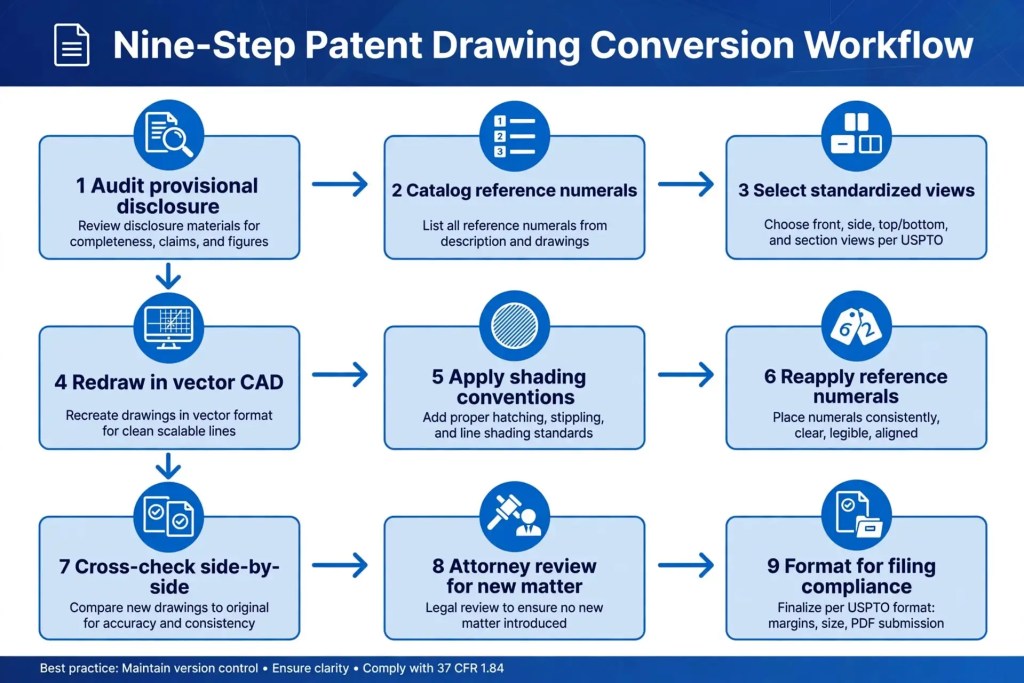
- Audit the provisional disclosure first. Before touching a pencil or stylus, review the provisional specification alongside the sketches. Note every feature, numeral, and relationship the text describes, since the drawings must support the written disclosure.
- Catalog every reference numeral and feature. Build a checklist of every labeled part, dashed line, and dimension shown in the original sketch so nothing gets silently dropped during redrawing.
- Select the correct standardized views. Determine which views, such as front, rear, side, top, bottom, perspective, or sectional, are needed to fully represent the invention, based on what the sketch already implies.
- Redraw using CAD or vector illustration software. Convert freehand lines into clean, uniform vector paths while preserving proportions, angles, and spatial relationships exactly as originally shown.
- Apply correct shading conventions. Add oblique line shading or stippling to represent three-dimensional surfaces, following USPTO drawing standards rather than photorealistic rendering.
- Reapply reference numerals consistently. Every numeral must match the specification text exactly, and lead lines must point clearly to the correct feature without crossing other lines unnecessarily.
- Cross-check against the provisional side-by-side. Place the formal drawing next to the original sketch and confirm every element traces back to something disclosed, with nothing added and nothing missing.
- Have the attorney review for new matter. Before filing, the prosecuting attorney should compare drawings and specification together to confirm no unsupported claim language has crept in through the redraw.
- Format for filing compliance. Finalize margins, paper size, numbering sequence, and figure labels to meet 37 CFR 1.84 before submission with the nonprovisional application.

Following this sequence in order matters. Skipping the audit step, for instance, often leads illustrators to “clean up” ambiguous sketches by guessing at intent, which is exactly where new matter tends to sneak in.
Common Mistakes That Undermine Priority During Conversion
Even experienced teams occasionally introduce errors during provisional to nonprovisional patent drawing conversion. Watch for these recurring pitfalls.
- Treating the redraw as a redesign opportunity. Improving the invention’s appearance or fixing perceived flaws during conversion introduces new matter, even if the intent was purely cosmetic.
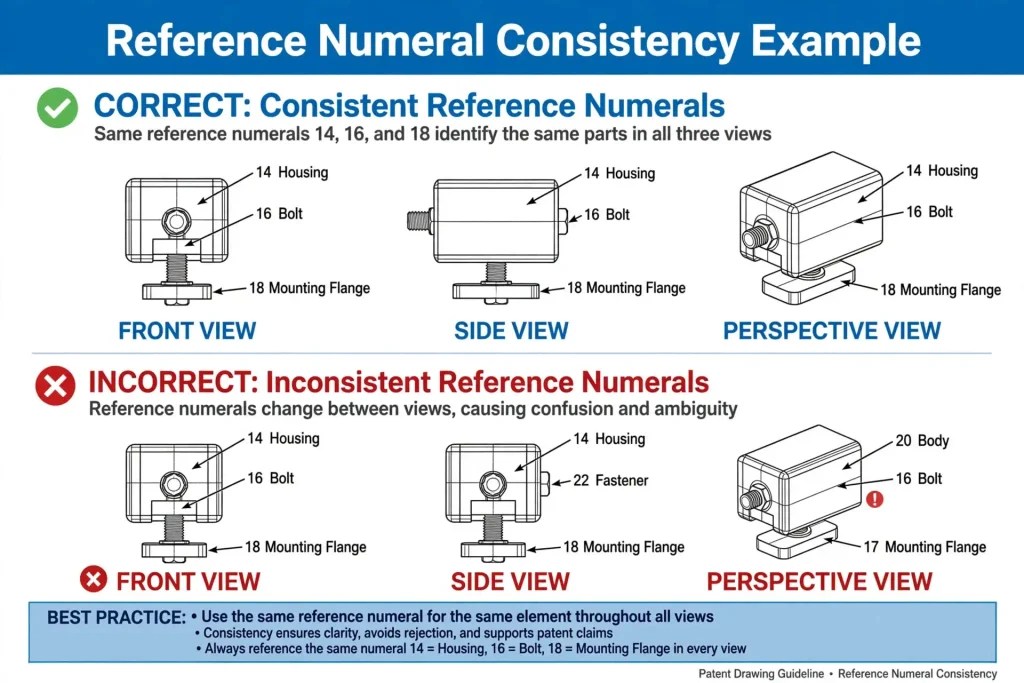
- Inconsistent reference numerals between figures. If a part is numbered “14” in Figure 1 but “16” in Figure 3, examiners will flag the inconsistency, and it can suggest the two figures depict different embodiments.
- Losing dashed-line conventions. Dashed lines typically represent environmental structure or optional features that are not being claimed; converting them to solid lines can inadvertently expand claim scope.
- Omitting a view because it seemed redundant. A view that looked unnecessary to a designer may actually be the only figure showing a claimed spatial relationship.
- Ignoring specification cross-references. If the written description mentions “as shown in Fig. 4,” but Figure 4 was renumbered or removed during conversion, the mismatch confuses examiners and can trigger objections.
- Rushing the process near the 12-month deadline. Provisional applications convert or must be refiled as nonprovisional within twelve months, and last-minute redraws under time pressure are where most detail loss happens.
- Relying on non-specialist designers. General graphic designers often do not know USPTO shading rules, line weight standards, or numbering conventions, which leads to formal objections that delay examination.
Expert Tips for a Clean, Priority-Safe Conversion
Drawing on established patent prosecution practice, here are practical tips that reduce risk during conversion.
- Start the conversion early, ideally several months before the 12-month deadline, rather than waiting until the final weeks.
- Keep the original provisional sketches archived in their original form, since they may need to be referenced again during prosecution or in a later infringement dispute.
- Use consistent software and templates across all figures so line weights, arrow styles, and shading remain uniform throughout the drawing set.
- Loop in the attorney before finalizing, not just at the end, so the legal team can flag ambiguous features while there is still time to clarify them with the inventor.
- Request markup or redline versions from your illustrator that highlight exactly what changed between the sketch and the formal drawing, making attorney review faster and more reliable.
- Consider PCT-compliant formatting from the start if you plan to pursue international protection, since PCT patent drawing requirements differ from USPTO rules in several respects, including margin sizes and numbering conventions.
When the Source Material Is CAD Rather Than a Sketch
Some inventors file provisionals with rough CAD exports instead of hand sketches. While CAD-based sources generally reduce ambiguity, they introduce a different challenge: CAD models are often built for manufacturing, not for patent disclosure, and they frequently include excess detail, such as bolt threading or surface textures, that has nothing to do with the claimed invention.
Converting these files correctly means selectively simplifying the drawing, stripping out irrelevant manufacturing detail while retaining every claimed structural feature. This is a related but distinct discipline covered in depth in our guide on turning engineering or CAD drawings into examiner-ready patent figures, which walks through how to separate claimed structure from incidental manufacturing detail.
Design Patents: A Special Case for Conversion
If your provisional covers ornamental design rather than utility function, the conversion process changes considerably. Design patent drawings must show the claimed ornamental appearance with even greater precision, since the drawing itself defines the scope of protection rather than merely illustrating written claims.
For design applications, examiners check a specific set of formal requirements before anything else, and missing even one can result in a drawing objection. Our design patent drawing checklist covering the 12 formal requirements examiners check first is a useful companion resource if your provisional sketches are headed toward a design, rather than a utility, nonprovisional filing.
The Legal Framework Behind Priority Detail Preservation
Understanding why provisional to nonprovisional patent drawing conversion carries so much weight requires a brief look at the legal mechanics involved. Under 35 U.S.C. § 119(e), a nonprovisional application is entitled to claim the benefit of a provisional’s filing date, but only for subject matter that the provisional actually and adequately discloses. This is often referred to as the written description requirement, and drawings are treated as part of that disclosure.
In practice, this means examiners, and later courts if the patent is litigated, will ask a simple but consequential question: does the provisional, as filed, reasonably convey to a person skilled in the art that the inventor possessed the claimed feature at that time? If the formal drawing shows something the sketch does not support, the answer is no, and priority is lost for that portion of the claim.
This legal reality explains why patent attorneys treat drawing conversion as a substantive prosecution task rather than a purely artistic one. A few practical consequences follow:
- Partial priority is possible. Some claims in a nonprovisional application may retain the provisional’s priority date while others, relying on later-added detail, do not. This split can happen within a single application.
- Intervening prior art becomes relevant. If priority is lost for a claim, any prior art published between the provisional and nonprovisional filing dates can now be used against that specific claim during examination.
- Continuation strategy may be affected. Applicants sometimes file continuations or continuations-in-part specifically because drawing conversion revealed gaps in the original disclosure, which changes overall prosecution strategy and cost.
Because these consequences are strictly legal in nature, illustrators cannot make these calls alone. The conversion workflow described earlier deliberately builds in an attorney review step precisely so that legal judgment, not just drawing accuracy, gets applied before filing.
Working With Your Patent Attorney During Conversion
Coordination between the illustrator and the prosecuting attorney is often the single biggest factor separating a clean conversion from a problematic one. Left to work in isolation, illustrators may make reasonable creative assumptions that conflict with the attorney’s claim strategy, while attorneys without drawing expertise may not notice a subtle shading or numbering issue until an office action arrives months later.
A few practices tend to produce the smoothest results:
- Share the claims draft, not just the specification, with the illustrator. Even in early stages, knowing which features are likely to be claimed helps the illustrator prioritize precision on those elements.
- Establish a single point of contact for questions. Ambiguities in a rough sketch are common, and a fast feedback loop prevents illustrators from guessing at intent.
- Schedule a mid-project review, not just a final one. Catching an interpretation issue halfway through redrawing is far cheaper than discovering it after all figures are complete.
- Ask for a change log. A short document listing every interpretive decision made during conversion, such as “assumed hinge rotates 90 degrees based on arrow in original sketch,” gives the attorney a clear audit trail to review quickly.
This kind of structured collaboration is standard practice among specialized patent drawing firms, but it rarely happens by default with general design freelancers who are unfamiliar with patent prosecution workflows.
Timeline and Cost Considerations for Drawing Conversion
Budgeting time and money for provisional to nonprovisional patent drawing conversion is easier when you understand the variables that drive both.

Timeline factors include:
- Number of figures. A simple mechanical device might need four to six views, while a complex system with multiple embodiments can require twenty or more.
- Source material quality. Clean CAD exports convert faster than ambiguous hand sketches, which often require clarifying questions before redrawing can proceed.
- Attorney availability for review. Since attorney sign-off is a required step, delays in scheduling that review can extend the overall timeline even when the drawings themselves are ready.
- Revision cycles. Most conversions go through at least one or two rounds of revision after the initial attorney review, particularly for inventions with several moving parts.
Cost factors include:
- Complexity per figure. A simple exploded view costs less to produce than a detailed sectional view showing internal mechanisms.
- Total figure count, since pricing is typically structured per figure or per view.
- Rush turnaround, which many illustration firms price at a premium when the twelve-month deadline is close.
- Design patent requirements, which often demand more precise line work and additional views compared to utility drawings, affecting overall cost.
Planning conversion work several months ahead of the twelve-month deadline, rather than in the final weeks, generally reduces both cost and risk, since it allows time for thorough review without rush fees or compressed revision cycles.
Practical Insights From Real-World Conversion Projects
Drawing on patterns seen across hundreds of provisional-to-nonprovisional conversions, a few practical insights consistently hold true.
- Ambiguous sketches almost always need a clarifying conversation. Even experienced illustrators cannot reliably guess intent from a rough drawing, and skipping that conversation is one of the fastest ways to introduce unintentional new matter.
- Multi-embodiment inventions require extra care. When a provisional shows several variations of a design, conversion must clearly distinguish each embodiment in its own figure set, rather than blending features across variations.
- Software exports are not automatically formal-drawing-ready. Even a clean CAD file typically needs shading applied, unnecessary manufacturing detail removed, and reference numerals added before it satisfies 37 CFR 1.84.
- Digital markup tools speed up attorney review considerably. Providing side-by-side, annotated comparisons between the sketch and the formal drawing lets attorneys review changes in minutes rather than hours.
- Early conversion often surfaces disclosure gaps while there is still time to fix them. Occasionally, the process reveals that a feature described in the specification was never actually shown clearly in any sketch, giving the attorney an opportunity to address the gap through claim drafting or, if necessary, an updated filing strategy, before the deadline passes.
Featured Snippet Summary: The Conversion Process in Brief
Provisional to nonprovisional patent drawing conversion, in short, means redrawing informal sketches into formal black-and-white line drawings that comply with 37 CFR 1.84, while ensuring every feature, numeral, and relationship shown in the original provisional is faithfully preserved. The process typically involves:
- Reviewing the original disclosure and sketches together.
- Cataloging every feature and reference numeral.
- Redrawing in vector format with correct shading and views.
- Cross-checking the formal drawing against the original sketch.
- Having the attorney confirm no new matter was introduced.
- Formatting the final drawings for USPTO filing compliance.
Frequently Asked Questions
What happens if my nonprovisional drawings don’t match my provisional sketches?
If the nonprovisional drawings show features that were not clearly disclosed in the provisional, the examiner may treat those features as new matter. As a result, any claims relying on that added detail lose the benefit of the earlier provisional filing date and are instead examined against art published up until the later nonprovisional filing date.
Do provisional application drawings need to follow USPTO formal drawing rules?
No, provisional application drawings do not need to meet the formal requirements of 37 CFR 1.84. They must simply be legible enough to understand the invention. However, provisional to nonprovisional patent drawing conversion becomes necessary precisely because the nonprovisional filing does require full compliance with those formal standards.
How long does provisional to nonprovisional patent drawing conversion typically take?
Turnaround time varies with complexity, but a straightforward mechanical invention with a handful of views can often be converted within one to two weeks. More complex inventions, multi-embodiment disclosures, or CAD-heavy sources may take three to four weeks, particularly when attorney review cycles are included.
Can I convert my own sketches instead of hiring a professional illustrator?
Technically, yes, but doing so carries real risk. Without deep familiarity with 37 CFR 1.84 shading, numbering, and view conventions, self-converted drawings frequently draw formal objections from the examiner, which delays prosecution and can create inconsistencies that affect priority claims down the line.
What is the deadline for filing a nonprovisional application with converted drawings?
A nonprovisional application claiming priority to a provisional must generally be filed within twelve months of the provisional’s filing date. Missing that window means losing the ability to claim the earlier priority date altogether, so drawing conversion should begin well before the deadline approaches.
Does provisional to nonprovisional patent drawing conversion apply to PCT filings too?
Yes, if you plan to pursue international protection through the Patent Cooperation Treaty, your formal drawings must also satisfy PCT formatting rules, which overlap with but are not identical to USPTO requirements, particularly around margins and sheet numbering.
Conclusion
Provisional to nonprovisional patent drawing conversion is far more than a formatting exercise; it is the mechanism that carries your priority date safely from an informal filing into a fully examined application. Every reference numeral, dashed line, and proportion in your original sketch matters, because an examiner, and potentially a court years later, will compare the two drawing sets to determine exactly what you disclosed and when. Handled carefully, with a documented audit trail between sketch and formal drawing, conversion protects the very date your provisional application was filed to secure. Handled carelessly, it can quietly erode months or even years of protection you thought you already had.
If your twelve-month deadline is approaching and you want your formal drawings prepared correctly the first time, get a free patent drawing quote from PatentVisuals today and let an experienced illustration team carry your priority detail forward without compromise.
Additional reading: For a complete walkthrough of formal drawing requirements from the ground up, see our complete, examiner-ready guide to preparing patent drawings. For guidance from an authoritative primary source, refer to the USPTO’s General Information Concerning Patents and the Manual of Patent Examining Procedure, Chapter 600.

